Principal investigators:

Lynne Talley (ltalley@ucsd.edu) (SIO/UCSD)
Teresa Chereskin (tchereskin@ucsd.edu) (SIO/UCSD)
Andrew Dickson (adickson@ucsd.edu) (SIO/UCSD)
Rana Fine (rfine@rsmas.miami.edu) (RSMAS/U. Miami)
Laura Farias, Osvaldo Ulloa (lfarias@profc.udec.cl) (U. Concepcion)
Bernadette Sloyan (Bernadette.Sloyan@csiro.au) (CSIRO)
Summary:
AAIW is a low salinity water mass that fills most of the southern hemisphere and the tropical oceans at about 800 to 1000 m depth. As the densest of the circumpolar Subantarctic Mode Waters (SAMW), AAIW is formed as a thick, outcropping mixed layer in the southeastern Pacific just north of the Subantarctic Front (SAF). SAMW and AAIW formation have a major impact on the oceanic sink for anthropogenic CO2, whose largest uncertainty is at intermediate depths. Our plan is to characterize the AAIW formation processes, with a winter and follow-on summer hydrographic survey of the AAIW outcropping region and the fronts that bound it. Shipboard measurements include CTD, salinity, oxygen, nutrients, XCTD, ADCP, LADCP, shipboard meteorology, CFCs, CO2, underway N2O and CO2, underway T/S/O2. We will deploy floats for ARGO and a surface drifter with a pCO2 sensor.
Full text of NSF project summary
National Science Foundation Ocean Sciences Division Grant OCE-0327544

Final data sets and cruise reports

Principal investigator and principal contacts list (as of 10/20/05)


Index:
Links to Apex profiling floats, ARGO floats, SST images, altimetry, quickscat, weather, wave height, sea ice
Winter 2005 cruise (Aug-Oct 2005)
Summer 2006 cruise (Jan-March 2006)
Publications
Abstracts
CLIVAR
Collaborations
Some background information

Links

Apex floats (Jan, 2006 - present)
Real-time satellite product page for this region (G. Goni and J. Trinanes, NOAA/AOML). Updated every day.
SST image for planning: October 3, 2005.
Link to all SST images, including daily update of station locations. Updated October 4, 2005.
Link to all merged altimetry sea surface height anomalies (Aviso) Updated October 19, 2005.
Significant wave height and direction maps: U.S. Navy WW3-Global analysis.
Weather forecasting information (Australia Bureau of Meteorology)
Historical hydrographic data (1980 McCartney; WOCE sections)
ARGO float results (Jamie Holte, SIO graduate student)
Sea ice: Bellinghausen west (60W to 90W) (NOAA National Ice Center)
Sea ice: Amundsen East (90W to 115W)(NOAA National Ice Center)

Winter (Aug-October) 2005


Combined cruise report: CTD, bottle sampling, XCTD, ADCP, LADCP, CFCs

AAIW Knorr 2005
Cruise track: August. 21 - October 6, 2005
Teresa Chereskin, Chief Scientist

WHP format sum file (station information)

Materials from during cruise:
Occasional cruise notes from Teri Chereskin

Images for choosing special survey regions
As of August 19, these suggest that the SAF has been shifted northward throughout the winter in the target region for the convection survey. Therefore we might expect deepest mixed layers to also be shifted northward (north of the SAF). SST pattern indicates a developing ridge of cold water, just north of the current location of the SAF (based on altimetry). Hence, as of today (prior to any CTD profiling for verification), it would appear that the convection study should be located at the breakpoint station at 77W (centered at 57S, 77W).
August 20 update: microwave SST map shows weaker low temperature (not apparent in coarse colloring in Goni maps). However, lowest temperature is still at the first leg breakpoint.
August 21 and 22 update: MW SST shows warming of surface.
Aug. 24: deep mixed layers detected (8/24/05)
Aug. 26: Subantarctic Front detected and second intensive survey planned (8/26/05)

SST August 16, 2005 (pdf) from TRMM (Goni webpage below), with cold patch suggesting SAMW formation region, and revised station pattern
Global SST August 18, 2005 (gif) (Australian BoM)
SST August 20, 2005 (jpg) data from TRMM, plot made with finer contouring than Goni webpage, with cold patch suggesting SAMW formation region, and revised station pattern
SST August 21. Surface warming throughout.
SST August 22. Surface warming throughout.
SST August 23. Shift of cold patch slightly to east, more at station 6 than at corner point.
SST August 24. Shift of cold patch more to east. Mixed layer special
SST August 25.
Altimetry August 10, 2005: SSH anomaly (Aviso/Holte webpage below). Anomalies at 77 to 80W have persisted since June/July, reflecting northward shift of SAF.
Altimetry August 10, 2005: geostrophic velocity (Aviso/Holte webpage below). Showing northward shift of SAF. Compare with SST pattern above.
Altimetry August 10, 2005: Dynamic topography (Aviso/Holte webpage below). Showing cyclonic feature coincident with cold SST, just north of shifted SAF.
Altimetry near end of cruise: September 17, 2005: SSH anomaly.
Altimetry near end of cruise: September 17, 2005: Geostrophic velocity.
Altimetry near end of cruise: September 17, 2005: Dynamic topography.


Summer (Jan-March) 2006

Combined cruise report: CTD, bottle sampling, XCTD, ADCP, LADCP, phytoplankton, pCO2

AAIW Knorr 2006
Cruise track: Jan. 30 - March 14, 2006
Bernadette Sloyan, Chief Scientist

WHP format sum file (station information)

Jamie Holte's weblog for the Jan.-March, 2006 R/V Knorr cruise


Publications

Dong, S., S. Gille, J. Sprintall and L. Talley, 2008. Southern Ocean mixed-layer depth from Argo float profiles. J. Geophys. Res., 113, C06013, doi:10.1029/2006JC004051.

Holte, J. and L. Talley, 2008. A new algorithm for finding mixed layer depths with applications to Argo data and Subantarctic Mode Water formation. Submitted to J. Atm. Oceanic Tech.

Sloyan, B., L. D. Talley, T. Chereskin, R. Fine and J. Holte, 2008. Subantarctic Mode Water formation: the role of turbulent mixing. Submitted to J. Phys. Oceanogr.

Abstracts

2006
Talley, L., T. Chereskin, J. Holte, Y-D. Lenn, 2006. Subantarctic Mode Water and Antarctic Intermediate Water formation near the Subantarctic Front in the southeast Pacific in winter 2006. Ocean Sciences 2006, session OS075.
pdf of Abstract. Link to powerpoint presentation

Carter, B., A. Dickson, L. Talley, R. Fine, T. Chereskin, J. Holte, 2006. An estimate of carbon sequestration via Antarctic Intermediate Water formation in the austral winter of 2005. Ocean Sciences 2006. pdf of Abstract.

2007
Talley, Chereskin, Sloyan and Holte, 2007. Winter observations of Antarctic Intermediate Water and Subantarctic Mode Water formation in the southeast Pacific. IUGG 2007, Perugia, Session PS002.

2008
Cerovecki, I., L. Talley and M. Mazloff, 2008. SUBANTARCTIC MODE WATER AND ANTARCTIC INTERMEDIATE WATER FORMATION. 2008 Ocean Sciences Meeting, Orlando, FL, Session 169.

Holte, J., L. Talley, T. Chereskin, B. Sloyan, 2008. OBSERVATIONS OF SUBANTARCTIC MODE WATER MIXED LAYERS AND ANTARCTIC INTERMEDIATE WATER DURING AUSTRAL WINTER 2005. 2008 Ocean Sciences Meeting, Orlando, FL, Session 169.

Carter, B., A. Dickson, L. Talley, T. Chereskin, J. Holte, C. Hartin, 2008. AN INVERSE MODEL TO SEPARATE MIXING FROM GAS EXCHANGE IN THE REGION OF AAIW FORMATION. 2008 Ocean Sciences Meeting, Orlando, FL, Session 169.


CLIVAR

This project is a contribution to international CLIVAR, under the acronym SAMFLOC (SubAntarctic Mixed layers, FLuxes and Overturning Circulation).

Text of funded proposal (pdf)


Collaborations

  • Chile U. Concepcion: Osvaldo Ulloa/Laura Farias/Wolfgang Schneider/Samuel Hormazabal/Oscar Pizarro
    FONDAP funding as a Chilean national center of excellence.
    Underway pCO2 and pN2O on US hydrographic surveys. FONDAP funding, to be carried out on the US intensive surveys, assuming they are funded.
    Hydrographic study 32S from coast west to 103W, south to 43S, east to coast (late 2003). FONDAP, funded.
    Click here for cruise schematic
    Cimar cruises around 43S (salmon).
  • Chile (SHOA) Rodrigo Nunez
    Repeat hydrography winter and summer 20S to 45S out to 75W, Juan Fernandez and Easter Island
  • ARGO and Canada (IOS, U. Victoria, Acadia U.):
    Howard Freeland, 10 to 40 ARGO floats (Canadian Southern Ocean program and contribution to ARGO). Six floats were deployed in early 2003.

    Public access ARGO data (not collaboration with our project of course) include many floats in the SE Pacific.

    The ARGO data are publicly available and are online. Check these:
    U.S. ARGO site
    U.S. ARGO GODAE data server - direct access to data (suggest using GDAC Data Browser)
    French ARGO ftp site
    Canadian ARGO site - focus on G. Alaska, dig to find SE Pacific
    Japanese ARGO site

    Andrew Weaver, Richard Karsten modeling interest

  • Link to global drifter center

    Some useful figures

    Schematic of SAMW/AAIW processes, showing: (1) inflow from subtropical gyre and outflow to Drake Passage and subtropical gyre subduction (green), (2) northward Ekman transport at the Subantarctic Front creating intrusions/ mixing, fed by upwelling from below and deep flow southward across the front (blue), (3) upwelling driven by Ekman suction north of the SAF (as per all observations - see Fig. 2), preconditioning the region for convection (purple), (4) eddy fluxes across the SAF (gray), (5) air-sea fluxes including heat/salinity balances and also wind stirring (light blue). The shaded brown shape represents the base of the surface layer. (from Talley/Chereskin proposal)


    Subduction into the southern hemisphere subtropical gyres is dominated volumetrically by Subantarctic Mode Water and the densest of the SAMW's, Antarctic Intermediate Water (AAIW). SAMW refers to the thick mixed layers found directly north of the Subantarctic Front. A map of a proxy of winter time mixed layer depth ( Fig. 1 from Talley, 1999) shows that these layers are thickest in the eastern Indian Ocean and all across the Pacific. The sudden onset of thicker layers in the central Indian Ocean is a mystery to be solved.


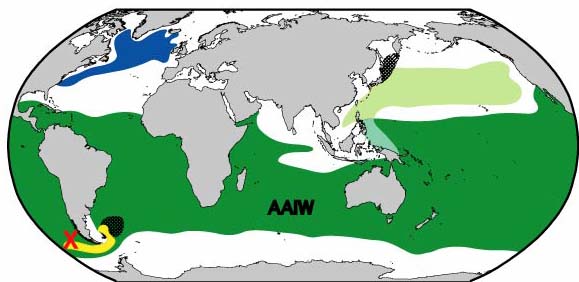
    In the Pacific Ocean, the densest subducting layer is the densest of the global SAMWs, and is identical there to AAIW. AAIW is formed in the southeastern Pacific, just west of southern Chile, from where it spreads to the entire southern hemisphere and tropics throughout the globe (schematic in Fig. 3, from Talley, 1999). The Pacific AAIW salinity minimum originates from this single source region, through northward subduction. The AAIW found in the Atlantic and Indian originates primarily from this source as well, as a portion of the new AAIW flows eastward through Drake Passage, north of the Subantarctic Front. Some modification of the AAIW takes place during this passage and then it spreads into the South Atlantic's subtropical gyre through eddy shedding and mixing out of the Falkland (Malvinas) loop. (This is not a wind-driven subduction process.) Based on oxygen, potential vorticity and salinity in the Atlantic and Indian Oceans, there is no source of AAIW in these oceans other than the southwestern Atlantic. Hence the primary site to study for AAIW formation is the southeastern Pacific, and the primary sites to study for AAIW spreading are Drake Passage and a subtropical section such as the quarterly XBT line at 30S in the Pacific.


    Why are these dense and volumetrically large subducting water masses important for climate? They form a large fraction of the subducted water of the subtropical gyres. They spread northward and cross the subtropical/tropical potential vorticity barrier and are found in a weaker form in the tropics. Variations in Southern Ocean surface properties are therefore communicated throughout the subtropical southern hemisphere and into the tropics through these water masses. In the Atlantic, AAIW is a marked part of the warm layer that moves northward, feeding the North Atlantic thermohaline overturning.

    For several decades there have been two separate ideas about SAMW and AAIW formation.

    (a) The older concept was that AAIW is formed circumpolarly, through Ekman transport northward across the Subantarctic Front and then sliding northward down isopycnal surfaces.

    (b) A more recent concept (still dating to the 1970s, McCartney, 1976) is that SAMW is formed north of the Subantarctic Front through subtropical gyre processes and that AAIW is the densest of the SAMWs, and hence localized in its formation area. (SEISAMW has been recently recognized as a similarly important water mass with respect to its ventilation of the Indian Ocean. )

    Both mechanisms are likely active. The northward Ekman transport across the SAF occurs into the local SAMW layer and may be important for creating the great thickness of the SAMW layer. WOCE hydrographic sections show intrusions across the SAF into the SAMW. Eastward transport of the SAMWs then eventually leads to both new SEISAMW, subducting into the Indian Ocean, and new AAIW, partially subducting into the Pacific Ocean and partially passing on to the Atlantic/Indian subtropical gyre. The second source of water for the SAMW and AAIW is subtropical circulation poleward in the western boundary currents, in the traditional model of subtropical subduction.

    In the region south of Australia, Rintoul et al (JPO, submitted) have looked at correspondences between Ekman variability, SAMW properties and atmospheric variability and found that Ekman transport across the SAF should not be ignored.

    For postscript versions of the plots: Click these with the right mouse button.
    Figure 1 postscript (winter mixed layer based on oxygen proxy)
    Figure 2 postscript (Indian Ocean PV in SEISAMW)
    Figure 3 postscript (intermediate water distributions)

    Sources for figures

    McCarthy, M. C. and L. D. Talley, 1999. Three-dimensional potential vorticity structure in the Indian Ocean. J. Geophys. Res., 104, 13251-13267.

    Talley, L. D., 1999. Some aspects of ocean heat transport by the shallow, intermediate and deep overturning circulations. In Mechanisms of Global Climate Change at Millenial Time Scales, Geophys. Mono. Ser., 112, American Geophysical Union, ed. Clark, Webb and Keigwin, 1-22.


    Updated October 23 2008 L. Talley